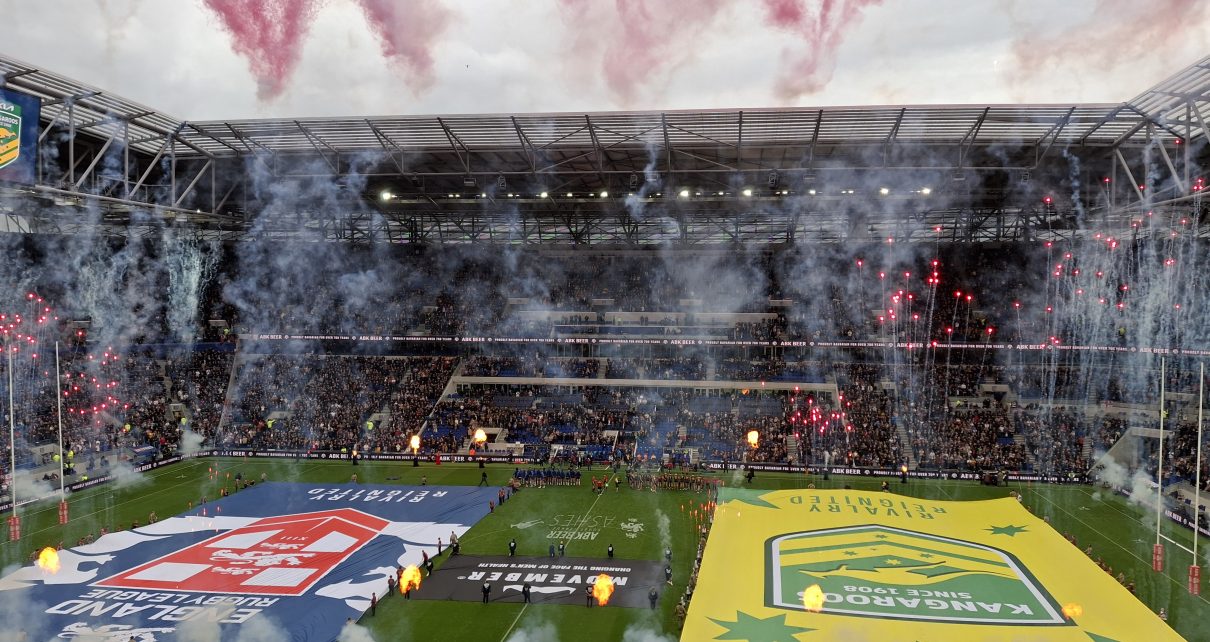
Brian McDermott took charge of his first England game since his April appointment, as England struggled to turn promise into points.
The 2025 Ashes series, the first since the early 2000s, was eagerly anticipated in the Rugby League world, with England hoping to prove they were still intact against the Aussies, undoubtedly the best team in the world.
The series would not play out that way, with the tourists winning all three games, while seemingly not needing to get out of second gear.
There were moments for England in that series, however. After a dismal opening match, in front of more than 60,000 fans at Wembley stadium, the series would head to Merseyside, at the Hill Dickinson Stadium, becoming the first non-football event to take place at the new state-of-the-art arena.
The opening 40 provided some hope for the 52,000 crammed into Everton’s home, but after a poor second half, all hopes of a first series win against Australia since the 1970s were gone, as the visitors took an unassailable 2-0 lead into the final test at Headingley.
The lacklustre attack at key moments was the story of the series for England a year ago, and despite off-field changes, it was the same old story for England, who got off to the worst possible start in the latest iteration of the sport’s most prestigious competition.
The Ashes series brought an end to Shaun Wane’s tenure as England boss, following a review of the series in January 2026, with the search for his successor beginning shortly after.
After a three month process, former Leeds Rhinos coach Brian McDermott was the man tasked with guiding England through the World Cup. A change of approach was required if the Three Lions were to be able to compete with the world’s best.
Four grand Final victories between 2011 and 2017, as well as two Challenge Cups, a League Leaders’ shield and World Club Challenge make him the most successful coach of the modern era, underlining the pedigree he brings to the job.
With no warm up games and only a week of preparation down under, McDermott’s first task as the new boss seemed almost impossible, and was made even harder following the disappointing result on Saturday.
England arrived in Perth, Western Australia, as the fifth favourites to take home the title, an almost unprecedented stat, but one that highlights not only how England have fallen behind, but the rise of the Pacific nations.
However, former England international Brett Ferres believes former coach McDermott has the qualities needed to turn England’s fortunes around.
Ferres featured in all five of England’s matches at the 2013 World Cup, scoring three tries as the home nation reached the semi-final, before late heartbreak saw them exit the competition at the hands of then reigning champions, New Zealand.
The former forward played under McDermott during his time at Leeds, featuring in the Rhinos’ Grand Final victory over Castleford in 2017, giving him a first hand experience of McDermott’s coaching.
Speaking to Parklife Sport, Ferres highlighted his exceptional man management skills and his ability to get his team playing the McDermott way.
“Time has been precious, but what Mac does have is great people skills and an ability to get his team playing the way he wants them to.
“I imagine there will be some trick shots, and some different things in there, but he has a proven track record wherever he has been.
“He was fantastic at Leeds during my short time there, and obviously what came before that. He has all the attributes to succeed and get the best out of them players.”
Ferres’ comments point towards the unpredictable nature of the England attack that McDermott seeks to bring into the Three Lions, with the Tonga match offering the first indication as to how that approach will translate on the field.
On the surface, a 30-12 makes it easy to assume England were completely outplayed and didn’t stand a chance, and while there were moments for the Tongans, stats would suggest that England were on top for large parts of the game.
The numbers suggest there is hope for England
Fans were promised a revolution to the attack, following, it has to be said, the warranted criticism of Wane’s approach. And the difference was noticeable almost immediately.
Under Wane, to fans, the philosophy looked to be five drives and a kick, whereas under McDermott, the willingness to promote the ball and keep the play alive was there for all to see.
England registered 26 offloads in the opening game of the tournament, more than any other side in the men’s competition, and 21 more than their opponents. The figures offered a clear indication of the change in mentality, with England looking to play with greater freedom and take more risks in possession.
That approach created opportunities, with England recording six line breaks as they looked to stretch the Tonga defence, but, for the most part, they were just opportunities. When in and around the Tonga goal line, those same issues from a year ago arose. A lack of ability to breach the defence and put significant points on the board.
Those weren’t the only stats to suggest England have more potential. They made more metres, 1,513 to 1,462. Their average set distance was higher, 36.91 to 34.01. Kick return metres were higher, 113 to 95, and they made more passes, 247 to 192.
The stats don’t suggest England should’ve been on the end of an 18-point defeat, but the performance was disjointed, messy and error-stricken, with England making 16 to Tonga’s 10, including some comical mistakes when the pressure ramped up.
But, compared to 12 months ago, it seems that there is light at the end of the tunnel. During England’s final match of the Ashes series, they recorded just 14 offloads and two line breaks, a huge difference in approach, showing that there is reason to be hopeful for England under McDermott, even if it doesn’t come in this World Cup.
England’s status as fifth favourites reflects the growing strength of the international game, especially the Pacific nations, with Tonga and Samoa driving the standards and becoming increasingly capable of challenging the traditional powers.
The gap between those sides and the likes of Australia and New Zealand has narrowed, as NRL talents with heritage in those countries choose to represent their heritage over anything else.
Players representing their heritage is not a new concept in sport, or Rugby League. In the Rugby League world, Lebanon are a prime example of this, with their squad being made up of Lebanese expats in Australia, while in the FIFA world cup, there were 99 French born players in the competition.
The start of this uprising of the Pacific nations can be traced to 2017. Prior to the start of the 2017 World Cup, Jason Taumalolo chose to represent Tonga instead of New Zealand, a decision that was met with media backlash, despite being received positively across New Zealand. Taumalolo’s decision sparked a chane response, and came just one day later, with Andrew Fifita choosing to defect from Australia to Tonga, despite already being named in the Aussie squad.
Tonga would historically reach the semi-final that year, coincidentally seeing off New Zealand in the quarter-final, while also being seconds and a controversial call away from pulling off one of the greatest comebacks ever, in the semi-final against England.
Samoa followed a similar path in the 2022 tournament, as they reached the final, knocking England out in golden-point in the semi-final at the Emirates Stadium, to prove this was no coincidence, and these nations were real threats.
The progress has created more opportunities to play international rugby, and the introduction of the Pacific Championships in 2023 created a dedicated, annual competition for nations like Tonga, Samoa, Fiji, and Papua New Guinea to represent their nation, build connections and go toe-to-toe with strong opposition.
The increased opportunities have allowed these nations to build on their progress, rather than relying on the World Cup as their main chance to compete on the international stage. The challenge is for England to keep up with that progress being made in the Pacific, or risk getting left behind.
It isn’t just those nations benefiting from players choosing their heritage; however, England is also going down that route, a route McDermott said he would from day one. In total, there are five Australian born players in their World Cup squad: AJ Brimson, Max King, Victor Radley, Hugo Savala and Ben Talty, with Ferres believing those players offer plenty of reasons for optimism.
“There are some very exciting young players in the squad, and obviously a lot of the Aussie NRL-based boys with English heritage, which is exciting. It’s going to be really interesting to see how they go.”
The statistics show that McDermott’s attacking reforms are starting to take shape, but England must find a way to turn that promise into points.
They face France on Saturday, before playing PNG on Friday, October 30, two games that, on paper, England should win, but they will need to address the lack of execution quickly, with time running out to turn their fortunes around.


